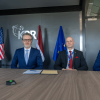


Initial public consultation of the Environmental Impact Assessment (EIA) report for the planned activity – establishment of a Sustainable Aviation Fuel (SAF and eSAF) production plant in the territory of the Liepāja Special Economic Zone.
Date and location of the meeting:
March 4, 2026, from 18:00 to 20:45
Assembly hall of Liepāja Technical School, Ventspils Street 51, Liepāja.
Moderator:
Oskars Beikulis, Lead Consultant at SIA “Estonian, Latvian & Lithuanian Environment”.
Participants:
- In person: 115 registered participants (not all attendees registered);
- Online: 50 unique connections via Zoom.
Course of the meeting
The meeting is opened by the moderator, indicating that the meeting is taking place in a hybrid format and its purpose is to introduce the planned activity — a sustainable aviation fuel production plant. During the course of the meeting, presentations are planned from the environmental impact assessment developers, a representative of the Liepāja Special Economic Zone (LSEZ), and the project initiator. The meeting is being recorded in order to prepare the minutes of the meeting.
Environmental consultant Aiga Kāla explains that the environmental impact assessment (EIA) process is a clearly regulated procedure, which is to be carried out in cases where the planned activity could have a potentially significant impact on the environment. The decision on the application of the EIA procedure to the planned activity was adopted on 14 January 2026, based on Annex One of the law “On Environmental Impact Assessment”. Currently, the initial public consultation is taking place, which will be followed by the development of the terms of reference, or programme, at the State Environmental Service (SES). The preparation of the report, in which specific technological solutions and impacts will be assessed, is planned until the second half of 2026, when a repeated public consultation will take place. The process will conclude with an opinion of the State Environmental Service, which will contain mandatory requirements for the implementation of the project, and the final decision will be taken by the municipality.
LSEZ manager Uldis Hmieļevskis introduces the industrial history and economic development of the city. With regard to the new project, the LSEZ manager indicates that the plant will be located in the port operation area, which, according to the city planning, is intended for industrial development. He mentions examples of how modern terminals, such as the cement terminal in Karosta or the existing “NorSAF” terminal, are able to successfully coexist with residents, without creating dust or odour pollution.
The project initiator Jānis Kisiels, member of the board of LSEZ SIA “NorSAF”, informs that the company has been operating in the Port of Liepāja since 2010, when an oil base was acquired and fully reconstructed, creating one of the most modern terminals in the Baltics. The new plan envisages producing 100,000 tonnes of aviation fuel and 20,000 tonnes of biodiesel and biogasoline per year, using green electricity, second-generation bioethanol, green hydrogen and CO₂ gas. The amount of investment is planned at approximately 650 million euros, creating 200 direct and another 200 indirect jobs.
The SAF and eSAF technology with the patent name PureSAF has been developed in Sweden over a period of 19 years under the leadership of the company and research institute “Swedish Biofuels”. Its licensors and partners for implementation of the technology in practice for NorSAF will be the leading engineering technology company KBR, which has been supplying scientifically advanced technologies to NASA for 60 years. The PureSAF technology has been tested in military and civil aviation in the US Army and DARPA, and in the Swedish Army, and it complies with the strictest European Union decarbonisation requirements and the ReFuelEU mandate and quality criteria for both the final fuel and the raw materials. Kisiels emphasises that the project will promote Latvia’s energy independence and fuel security by producing fuel from local resources, as well as promote the development and profitability of green energy projects in Latvia.
Aiga Kāla supplements with technical information about the production process, indicating the main raw materials, the most important stages of the production process and the type of end product, as well as what the stages of the EIA process are, what happens in them, and what the next steps will be after the initial public consultation. The EIA report will assess air pollution, industrial accident risks, noise and waste management. Special attention will be paid to the placement of high-risk installations in relation to residential buildings and public buildings.
Proposals for the development of the programme may be submitted by residents until 12 March 2026 (inclusive).
QUESTIONS / SUGGESTIONS AND ANSWERS (or summaries):
Participant 1
- Where will the required volume of biomass for fuel production be obtained? This winter’s example shows that even feed grain was lacking in stores. Is it planned to import waste from outside to ensure the required biomass volume?
- Human safety is the number one defence priority. Should the project not provide for appropriate shelters in the Lauma and Velnciems districts in the event of an accident at the plant? In the case of the construction of this plant, that is also necessary.
- Where will the visitors of the motor track go, who currently actively use this place?
Jānis Kisiels:
On raw materials: for the first three years second-generation bioethanol will be used as a raw material, which is planned to be transported to Liepāja for processing. Around 2033 it is forecast that bioethanol production plants will develop in Latvia, which will use local resources, including lignin and other green components. As of today, Latvia exports approximately 3.5 million tonnes of wood chips and pellets per year — this is a significant resource. Thus, in the first phase the raw material will come from outside, but in the long term it is planned to use local potential.
On human safety: it is important for us that the economy grows, which means that the level of defence also grows. Investors and allies will also be interested in protecting their investments, therefore this project will serve as an insurance policy. The greatest threat is posed by the volume of substances in the reservoirs, which is not planned to be increased, but the volume present simultaneously in the technological process, which can explode, is significantly smaller than the product in the reservoirs, therefore the plant cannot increase the existing impact.
On the motor track: the company is already addressing the relocation of the motor track at the very beginning of the project. In cooperation with LSEZ, alternative locations are being identified. The company commits to help transfer the unique sand so that the new track is as similar as possible to the existing one.
Participant 2
- Does a similar plant already operate in Europe or in the world? In which country and with what capacity?
- Does Jānis Kisiels live in Liepāja? What does he think, will apartment and private house prices increase or decrease when such a plant is built nearby?
- According to the application, the plant will require 1.7 million cubic metres of water per year, while Liepāja residents in total use slightly more than 2 million cubic metres. Are discussions already taking place with SIA “Liepājas ūdens”? Will Liepāja residents not suffer from water shortage?
- Steam requires wood chips or gas – where will it be stored? Will burning wood chips not cause pollution to nearby houses?
- Will production be continuous? What will be the supply of raw materials and the transport of produced products – by trains or ships? What will be the generated noise?
Jānis Kisiels:
On similar plants: a similar plant operates in the USA; another one is planned in the United Kingdom. The plant will use already known industrial technological equipment, which will be arranged in a unique sequence with unique catalysts to adapt for SAF and eSAF production.
On place of residence: Jānis does not live in Liepāja, but has regularly travelled to Liepāja since 1997. It is important to him that people in Liepāja can breathe fresh air, as he himself runs or walks through the city towards the sea in the mornings.
On apartment prices: industrial investments usually lead to an increase in apartment prices due to increased demand, as shown by global statistics. We will need many employees and highly qualified specialists, and they will need places to live, which can promote the development of new real estate as well as the hospitality sector.
Aiga Kāla:
On water: in addition to the centralized water supply solution, the company is also studying the possibility of using technical water, as well as water treatment and reuse options. Aiga notes that the initial filling volume is quite significant, but water reuse and recirculation will be studied.
On combustion equipment: industrial combustion equipment produces significantly lower emissions than wood burned in households, as it is equipped with purification systems. The impact of air pollution will be calculated quantitatively and shown on a map in relation to the nearest residential houses.
On production volumes: the total volume of produced and handled products will be lower than the volume specified in the existing permit of the terminal.
Participant 3
- Claims that the process has not just started – last January a meeting already took place at the Latvian Society House, where aviation fuel production and hydrocarbon production in a school yard were discussed. Uldis Hmieļevskis was invited but did not attend. Believes that the public was misled.
- Claims that green energy is only a way for some people to make money, nothing more – compares it with the COVID situation.
- Claims that fuel prohibited in Europe was traded from the former Lauma oil base in Liepāja.
- Claims that Liepāja tram, water and heat are being prepared to be handed over to someone or privatized – that this is interconnected.
Aiga Kāla:
The EIA process formally started on 14 January 2026, when the decision on the application of the procedure was adopted. Various informal discussions and idea exchanges take place before a project reaches the start of the EIA process. The fact that the project has been discussed for a longer time does not mean that the EIA process started earlier.
Uldis Hmieļevskis:
Privatization of SIA “Liepājas tramvajs” and SIA “Liepājas ūdens” is not planned – there has not even been a discussion about it.
Jānis Kisiels:
On possible illegal fuel activities: no remarks have been received from the State Environmental Service or law enforcement authorities. If there are justified suspicions, it is recommended to contact law enforcement authorities and report.
Participant 4
- The questioner notes that near the territory there is a school and a nine-storey dormitory where approximately 400 minor children stay five days a week, as well as School No. 15. Currently, residents of Vānes Street feel odours during hot summer days – balconies cannot be opened. If the plant is built, the situation will worsen. Requests that children are not forgotten.
Aiga Kāla:
No one has forgotten about people. Air quality and noise standards are set specifically to protect human health. It is mentioned that accident risks will also be assessed. All assessments will include sensitive groups. The impact on air quality will be evaluated taking into account the distance to houses and schools.
Participant 5
Production processes are very heat-intensive and require large amounts of water for cooling.
- Where will the warm water go – will it be discharged into the sea?
- What will be the impact on the marine ecosystem?
Also expresses concerns about the impact of wind turbines, high-voltage lines and their negative effects on plants in residents’ gardens.
Aiga Kāla:
The best available techniques today do not allow direct discharge of warm water into the environment. A closed cooling cycle is mandatory. Heat recovery and cooling solutions will be evaluated.
Participant 6
- As one person to another – is there really no more suitable location for this project? Refers to Neste plants in the Netherlands (Rotterdam) and Sweden, where similar plants are located on port peninsulas at a minimum distance of 2–3 kilometres from residential areas. Asks Jānis Kisiels to indicate at least one alternative location outside a populated area.
Jānis Kisiels:
The location was chosen because there is existing infrastructure, the company operates in Latvia, and with existing infrastructure and proximity to the port the project can be implemented efficiently. The port of Rotterdam is a good example of how a port coexists with a city and residential areas – production facilities are also located in close proximity to the city. Similar examples exist in Sweden. The EIA process is carried out precisely to assess risks. Regarding an alternative location, he answered that the answer is both yes and no, without specifying concrete options.
The answer was not provided directly to this remark – the meeting moderator noted it as a remark rather than a question and continued the discussion.
Participant 7
Believes that the meeting discusses issues too narrowly and in too much detail, but does not answer pressing questions. Points to geopolitical risks, stating that threats similar to those in Ukraine exist and that a fuel production plant in Liepāja could become a strategic target.
Participant 8
- Proposes to establish continuous monitoring both for the planned activity and other LSEZ companies so that residents can see the data online.
- Where do the investments come from and what will happen if funding runs out halfway?
Aiga Kāla:
Indicates that modern technologies allow continuous monitoring (including odours), and monitoring conditions will be evaluated in the EIA process.
Jānis Kisiels:
Agrees that a project of this scale must ensure online monitoring.
On financial security: the project is financed by one of the largest institutional financial institutions of the European Union. The project will not be started until the full financial amount is guaranteed – it cannot stop halfway. Such confirmation has been received from investors and financial institutions.
Participant 9
Lives next to the existing terminal. Uldis Hmieļevskis showed a picture in the presentation demonstrating that the terminal and residential houses coexist well. However, at night a train moving back and forth causes noise and vibration.
Uldis Hmieļevskis:
Any train or truck creates noise and vibration – this is an objective fact. Regarding odours – the terminal technology is completely hermetic: gases are collected and not released into the atmosphere. This was the main point shown in the presentation image. It is possible that odours come from another source, not from the “NorSAF” terminal.
Participant 10
Residents have long struggled with odours from the surrounding area. Odours usually appear around 11 PM. They call the State Environmental Service office in Riga – they refuse and suggest calling the police. The police arrive, but the odours are gone. The next day they call the Liepāja environmental service – they come but also detect nothing, because the odours are gone. What to do if it is not possible to record the source of odours in time?
Jānis Kisiels:
The company operates within regulatory limits and has not received any remarks from the State Environmental Service. Safety reports are carried out within legally defined timeframes. The terminal’s main current products – bioethanol and imported fuels – are not such that would cause odours.
Aiga Kāla:
Currently, technologies allow continuous 24/7 odour monitoring (so-called electronic noses). Terminals in Ventspils are equipped with such devices. In the next phase of the project, monitoring will be evaluated and included in the EIA report.
Participant 11
Notes that Pulvera Street 8 has an unsuccessful history – three previously initiated projects (a malt plant, a coke plant and an oil processing plant) were not completed, and all three developers have been removed from the company register.
Raises several questions:
- Green hydrogen production via electrolysis requires 50 kW per kilogram – will electricity be ensured?
- Is there an alternative plan if the Pāvilosta wind park projects do not develop?
- Has water availability in Liepāja been studied over multiple years – will the water balance be sufficient for long-term production?
Jānis Kisiels:
On the history of Pulvera Street 8: does not want to repeat the scenario of the mentioned examples and notes that he is hearing about some of them for the first time. He also mentions that the latest development was the motor track, which is successfully operating.
On hydrogen: clarifies that the actual volume will be lower than stated, and hydrogen will be quickly converted into a stable product, which is one of the main innovations of this technology.
On electricity: it will be ensured even if the mentioned wind park projects do not develop.
On water: water consumption has been updated and the required volume is approximately 650,000 tonnes. Discussions with SIA “Liepājas ūdens” have already started. The process is optimized to reuse technical water and reduce groundwater extraction. Water consumption for hydrogen production will be minimized through several engineering solutions.
Participant 3
Expresses concerns about the financial stability of the project. Where and how will the invested funds go? Emphasizes that project partners are companies with questionable histories: companies outside Latvia that have gone bankrupt, as well as companies established with a share capital of 2,800 euros that will now handle billions. How can this be explained?
Jānis Kisiels:
On partner companies: does not understand which specific companies are being referred to. The attracted strategic investor has not gone bankrupt and has a turnover of approximately 3.2 billion per year; the holding includes approximately 120 companies with a total of 15,000 employees.
Participant 6
Does the Liepāja municipality plan to provide real estate tax relief or other forms of compensation to residents whose properties are located near the planned facility? Based on the claim that artificial intelligence indicates a possible decrease in property values.
Uldis Hmieļevskis:
Does not see grounds for real estate values to decrease – an increase is more likely. In cities that develop and where jobs are created, property prices increase, not decrease. In cities where nothing happens, prices decrease. In Liepāja, construction of six apartment buildings began in autumn 2025. Liepāja is the only place outside Riga and its surrounding region where private developers have started building apartment buildings. The city budget is not unlimited – economic development is necessary to finance utilities, culture, sports and education.
Participant 12
Question about logistics. The Raiņa–Kalpaka street crossing has been a transport problem in Liepāja for 20 years, and no solution has been found. What will be the solution so that residents do not have to stand in long queues due to additional railway cargo traffic? At one point, the entire Lauma district was blocked during reconstruction.
Uldis Hmieļevskis:
The current railway cargo volume in the port reaches 3.3 million tonnes per year. The planned plant’s total logistics volume of raw materials and finished products is a maximum of 200,000 tonnes per year – significantly less than current cargo, therefore no significant negative impact on traffic is expected.
On the Raiņa–Kalpaka crossing: specialists have found a technical solution, namely after completion of the reconstruction of Kalpaka–Raiņa street, a “green wave” traffic light system will be introduced, which will provide a longer green corridor after train movement. Reconstruction of Flotes Street with three lanes (two towards the centre) is also planned, which will improve public transport flow.
Participant 13
Question about safety in the context of geopolitical conditions – what is the view on human safety, specifically regarding shelters? Notes that considering events in Ukraine, it must be considered that if an enemy bomb arrives, not only the plant but also the entire surrounding area will suffer. Even without a direct hit, consequences would affect the entire neighbourhood.
Oskars Beikulis:
Indicates that the issue of shelters is not directly related to the operation of the plant and invites the next resident to ask a question related to the plant’s operation.
Participant 14
Raises objections regarding the location of the project. Will the facility have Seveso hazardous site status? When and where will the public be able to ознакомиться with this information? What are the three worst-case scenarios, for example in case of fire or explosion – what will be the impact zone in metres or kilometres? How will the public be warned (evacuation) – via SMS (modern option), emergency signals? Will a real warning system be ensured?
Aiga Kāla:
Determination of Seveso status (hazardous facility status) depends on how much hazardous substances will be stored simultaneously at the site. If the amount exceeds the defined threshold, Seveso status is mandatory – there is no choice.
This issue will be specifically assessed within the EIA.
Quantitative risk assessment will be carried out for all scenarios – the impact of thermal radiation and overpressure will be calculated and mapped to show where such effects could spread. Specific distances will be discussed at the next meeting after preparation of the EIA report.
A civil protection plan, including notification mechanisms, is a mandatory component of Seveso facility documentation. A realistic timeframe for finalizing this issue is approximately one to two years. Without inclusion of notification elements, further project development is not possible.
The moderator thanked the audience for their patience and interest, noting that this was a very good and disciplined audience.
It was reminded that written proposals for the environmental impact assessment programme may be sent to the State Environmental Service until 12 March.
The email address to which questions may be sent to the initiator of the planned activity was indicated ([email protected]).
The project initiator once again thanked everyone for the discussions and emphasised that the company is open to further conversations and suggestions.